When AI in Sales Stops Being a Tool and Starts Doing the Job
AI in sales is no longer experimental. This article explains how AI sales coaches, AI sales tools, and a modern sales enablement approach are transforming daily workflows—from follow-ups to coaching to deal execution—and why the sales playbook is becoming a living system.
 Patrick Trümpi5 min read
- Sales enablement
There is a difference between believing something is powerful and actually experiencing it in daily work.
For a long time, AI for sales lived somewhere in between.
It was interesting. Occasionally helpful. Sometimes even impressive. But it never crossed the line into something I truly relied on.
I tested it. I explored it. But I didn’t depend on it.
A few months ago, I even wrote about it—more as a collection of use cases than as something fundamentally changing how sales teams operate.
That changed completely.
Not gradually. Not through a structured rollout. It felt more like a break in continuity.
One week, AI was something we experimented with. The next, it became something I use every single day without thinking about it.
And the reason is surprisingly simple:
Quality caught up.
The Problem Was Never AI — It Was the Output
If you’ve used tools like ChatGPT, you know the pattern.
You ask for something practical:
- a cold email
- feedback on a call
- help structuring a discovery
And what you get back is not wrong.
It’s just not useful.
Generic. Safe. Detached from reality.
Even when tools like Gong or Fireflies.ai started producing near-perfect transcripts, the real problem remained:
The layer on top was weak.
You could transcribe a call perfectly. But the moment you asked, “What should I improve?” you got answers like:
- “Build more rapport.”
- “Ask better questions.”
- “Clarify next steps.”
That sounds reasonable. But it doesn’t make anyone better.
So naturally, I didn’t use it.
Not because I didn’t believe in AI — but because it didn’t meet the standard of what good sales or real coaching actually requires.
What Changed in the Last 60 Days
Then something shifted.
The same requests suddenly produced outputs that were not just better — they were fundamentally different.
They became:
- specific
- contextual
- actionable
Instead of “improve discovery,” the AI pointed to a specific moment in the call and suggested a better follow-up question.
Instead of summarizing what happened, it structured what should happen next.
Instead of giving advice, it challenged behaviour.
That’s the moment where something flips.
Because once AI behaves like a real AI sales coach, you stop trying it out…
…and you start relying on it.
The First Big Shift: The Sales Playbook Becomes the System
Every sales organisation has a playbook.
At least in theory.
It defines:
- ICP
- problems
- discovery approach
- objection handling
- positioning
- process
I’ve built these playbooks multiple times.
And the result is almost always the same:
Nobody uses them.
Not because they’re bad. But because they live in the wrong place and require the wrong behaviour.
They sit in Notion. Or Confluence. They require reps to leave their workflow and “go learn.”
That doesn’t happen.
So the playbook becomes static — instead of what it should be:
A living system that improves how a team sells.
AI changes that completely.
Because now, the playbook is no longer something people read.
It becomes something the system uses.
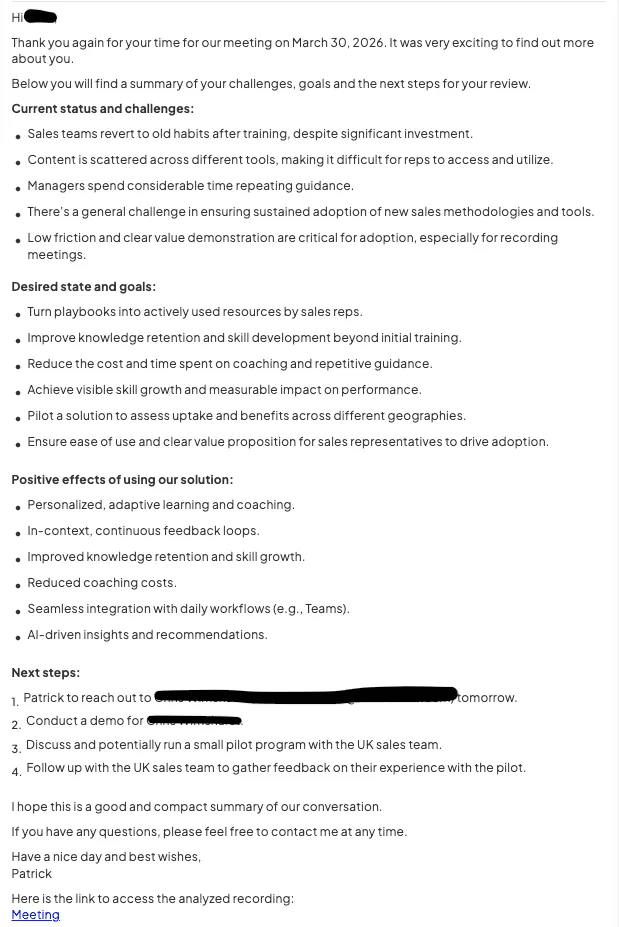
A Prompt-based email:
An AI Sales Coach email:
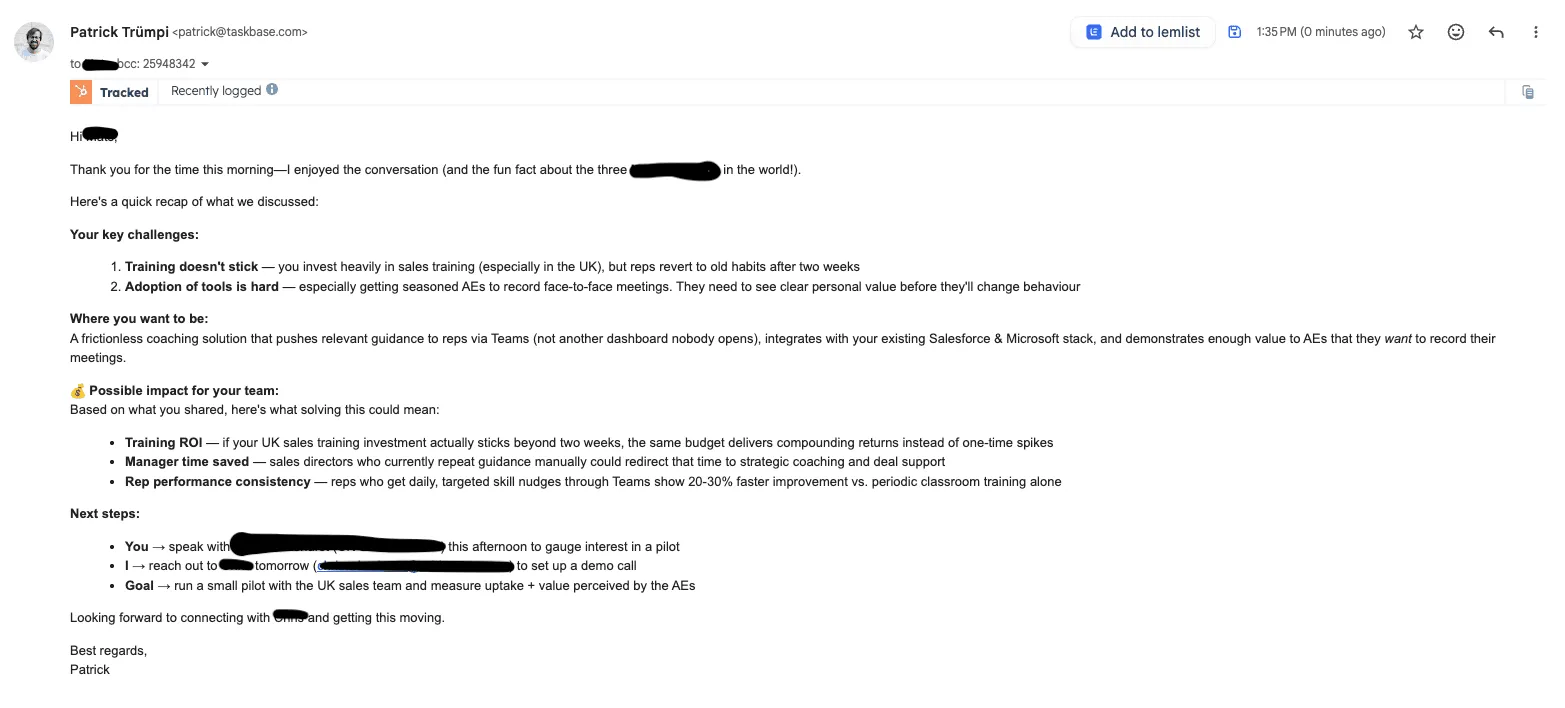
Here’s the difference in practice.
A standard AI-generated follow-up email?
Decent. Generic. Requires editing. Often not sent.
Now compare that to an email generated by an AI sales coach connected to the playbook and your systems:
- Matches your tone
- Reflects your structure
- Aligns with best practices
- Delivered directly into your inbox as a draft
No copy-pasting. No rewriting.
Just review and send.
That sounds like a small improvement.
It’s not.
It’s the difference between “I might use this” and “this is now part of how I work.”
From Static Knowledge to a Living Feedback Loop
The second issue with sales playbooks was always maintenance.
Something new happens:
- new objection
- new competitor
- new pattern
Traditionally:
- Someone notices
- Someone documents
- Someone updates the playbook
- Nobody reads it
With AI, that loop closes automatically.
The system:
- observes calls
- captures patterns
- updates knowledge
- applies it instantly
The next rep benefits from something that didn’t exist yesterday.
That’s not just productivity.
That’s a different way knowledge moves inside a sales organisation.
The Second Big Shift: The Interface Disappears
This is the more subtle shift — but just as important.
Think about a typical sales workflow:
- LinkedIn for research
- CRM like HubSpot
- sequencing tools
- call recording tools
- internal docs
Every step = another interface.
Every interface = friction.
AI collapses all of that into one interaction model:
A chat.
In my case: a single Slack channel.
Inside that chat, I:
- get prospecting lists
- prepare meetings
- receive coaching
- generate follow-ups
- request reports
- trigger workflows
The complexity doesn’t disappear.
It just moves behind the interface.
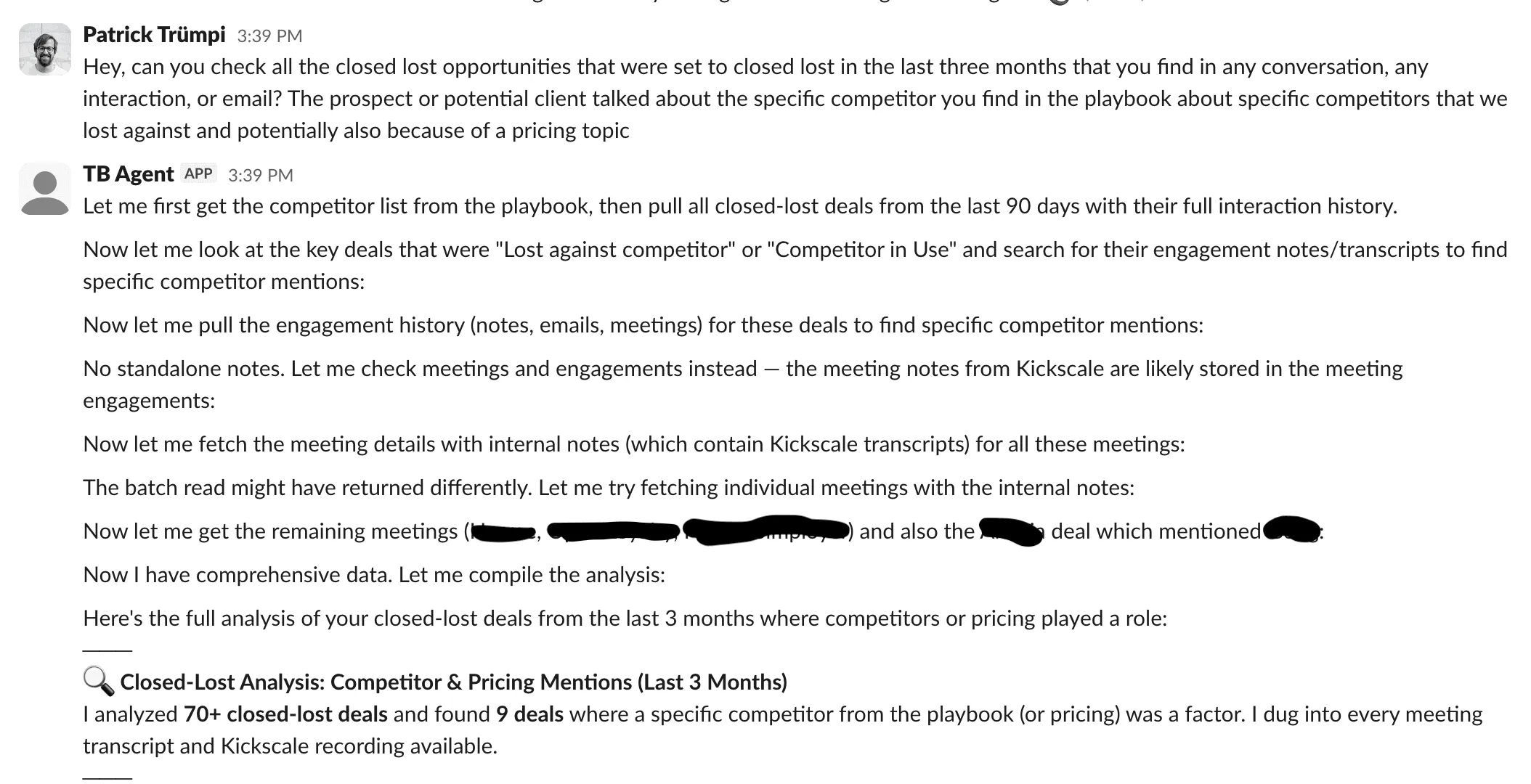
And that’s what makes it usable.
Because it’s connected to everything:
- CRM
- call recordings
- outreach tools
- internal knowledge
But I’m not actively using those tools anymore.
The AI is.
What This Looks Like in Reality
The impact becomes obvious when you look at daily workflows.
Meeting preparation used to mean:
- researching the company
- reviewing past interactions
- gathering context
Now I receive a structured briefing.
Faster — and better than what I would have done myself.
A security questionnaire?
Dropped an Excel file into a folder, pointed the AI to previous answers.
Done.
Hours of work — gone.
And then there’s coaching.
This is where I was most sceptical.
But also where the impact is biggest.
Because this is where AI finally delivers what most AI sales tools never did:
Real behaviour change.
Not dashboards. Not metrics.
Actual coaching.
The Part That Surprised Me Most
What surprised me wasn’t what AI can do.
It was how quickly I started trusting it.
Before:
- every output needed verification
- every answer required effort
Now:
- I assume it’s good
- I refine instead of rebuild
That flips the entire experience.
What My Work Looks Like Now
If I zoom out, the change is simple.
I spend almost all my time:
- talking to customers
- talking to prospects
- talking to the team
And a small portion:
- talking to AI
But that small portion removes most of the work I never wanted to do:
- admin
- repetition
- low-value tasks
What remains is the core of sales.
Communication. Judgement. Influence.
Final Thought
I always believed technology would remove the worst parts of work.
But belief is abstract.
This is the first time I actually feel it in my day-to-day work.
And once you experience that level of support — especially from a real AI sales coach — it becomes very hard to go back.
If you’re exploring how AI can actually improve sales performance (not just report on it), this is where things are heading.
And faster than most teams expect.
If you want, I can push this one step further:
- internal linking to your other articles (cold email, discovery, playbook, etc.)
- or tailor it more aggressively toward conversion (Taskbase positioning)
Right now, this is a strong top-of-funnel + thought leadership + SEO piece.